

Cart
0
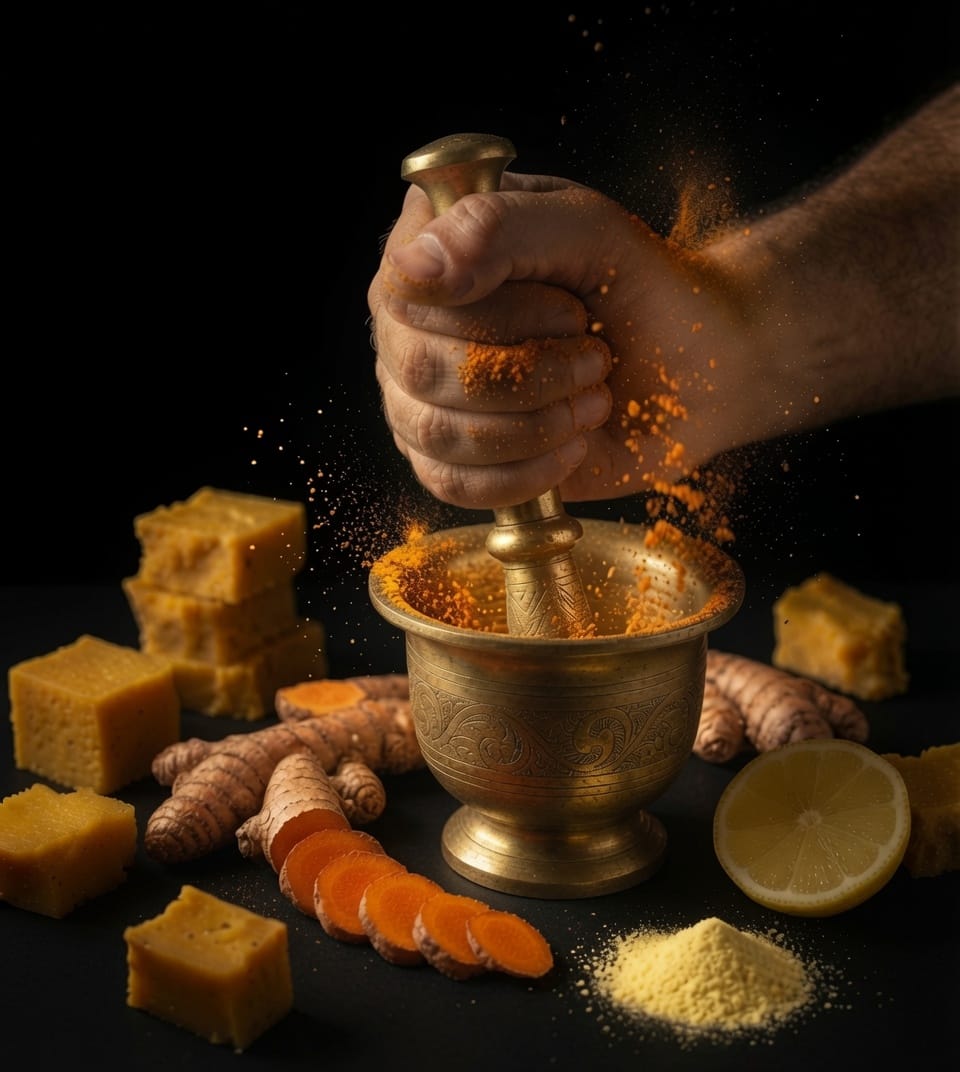
Kojic acid turmeric soap is everywhere right now. It fills TikTok feeds, sits in every online marketplace, and comes in a hundred nearly identical yellow bars. Most of them make the same promises. Very few of them explain what they actually are, or how to tell a good one from a bar that will do nothing for your skin except possibly irritate it.
I formulate skincare for a living, and I want to walk you through what to look at before you buy, in plain language. No hype, no miracle claims. Just what matters.
First, an honest word about what a soap can and can't do
A soap is a rinse-off product. It touches your skin for maybe thirty seconds, then it goes down the drain. That single fact should shape every expectation you have.
Kojic acid and turmeric are both studied for their effect on the look of uneven tone and dark spots. But an ingredient needs contact time to do anything, and a bar you rinse off gives it very little. So a good kojic acid turmeric soap is a supporting part of a routine that also includes things you leave on your skin, like a serum or moisturizer, plus daily sunscreen. It is not a treatment that erases dark spots on its own, and any bar that promises that is selling you the promise, not the result.
If a brand is honest about this, that is a good sign. If it promises to bleach, whiten, or permanently remove pigmentation, walk away. Those are drug claims, and a compliant, well-made soap will not make them.
Read the ingredient list before anything else
This is the single most useful skill you can have as a buyer, and it takes about ten seconds once you know what you are looking at.
Turn the bar over and find the ingredients. The first few ingredients are the bulk of the product. If you see something like Sodium Stearate, Sodium Laurate, Sucrose, Sorbitol, Glycerin at the very top, that bar is made from a pre-made melt-and-pour base. The maker melted a ready-made blank, stirred in a little color and fragrance, and poured it into a mold. There is nothing dangerous about this, but you should know it is closer to assembly than formulation, and it is what most of the cheap TikTok bars are.
A soap made from scratch, where the maker actually built the formula, reads differently. You will see the oils and butters that were saponified, listed by name, and the actives placed where they belong in the list. It is a different level of craft, and usually a different level of care about how the finished bar behaves on skin.
Neither one is automatically better for every person. But the ingredient list tells you which one you are holding, and whether the price matches what is inside.
Where the kojic acid sits on the list matters
Actives near the end of the ingredient list are present in small amounts. That is normal and often correct, since these ingredients work at low percentages. What you are checking for is whether kojic acid and turmeric are actually in the bar in a meaningful way, or just named on the front of the package for marketing while barely appearing in the formula.
You are also checking for supporting ingredients that make a bar gentler: things like glycerin, and nourishing oils or butters. A bar that is all cleansing agents and active with nothing to buffer it can leave skin tight and stripped, which is the opposite of what you want when you are trying to improve its appearance over time.
What about the pH warnings you see online?
You may have seen videos warning that kojic acid soap can hurt your skin because of high pH. There is a real point buried in there, so let me separate it from the fear.
All true soap is alkaline. That is chemistry, not a defect, and healthy skin handles it fine when the bar is well made. The problems people describe online almost always come from bars that were made carelessly: rushed production, no proper cure time, no extra nourishing oil left in the formula to buffer the cleanse. Those bars do leave skin tight, red, and unhappy, and there are a lot of them in the marketplace right now because this soap went viral.
A carefully formulated bar is cured for weeks before it is sold and keeps a reserve of skin-loving oils in the finished soap. You cannot see cure time on a label, but you can see who made it, how they talk about their process, and whether the ingredient list shows real oils and butters or just a ready-made base. If your skin is sensitive or eczema-prone, I wrote separately about why some natural soaps irritate reactive skin and what to look for instead.
A note on kojic acid versus kojic acid dipalmitate
You may see either one on a label. Plain kojic acid is the raw active. Kojic acid dipalmitate is a more stable, oil-loving version of it that holds up better over the life of a product, though the two are not identical in how they behave. Neither is a scam. It is just useful to know they are different forms of the same idea, so a label listing one instead of the other does not confuse you. What matters more is the overall quality and honesty of the whole formula, not which single form appears.
How to actually use it
Since contact time is short, the way you use the bar makes a real difference:
- Work it into a lather and let that lather sit on the skin for a short time before rinsing, rather than washing off instantly. This gives the actives a moment to do their small part.
- Use it consistently. Any change in the look of tone happens gradually, over weeks, not overnight.
- Wear sunscreen daily. Sun exposure is the main reason dark spots deepen, so skipping it works directly against everything the soap is trying to support.
- If your skin feels dry or tight, use it less often and always follow with a moisturizer.
The bottom line
A kojic acid turmeric soap is worth buying when the maker is honest about what it is: a well-crafted cleanser with actives that play a supporting role in a larger routine. Read the ingredient list, expect gradual change rather than miracles, and be suspicious of any bar that promises more than a rinse-off product can deliver.
This is exactly the standard I hold my own formulas to. Our Kojic Acid Turmeric Lemon Bar is made from scratch in small batches, saponified from whole oils and butters, cured fully, and described to you the same way I described everything above: honestly.